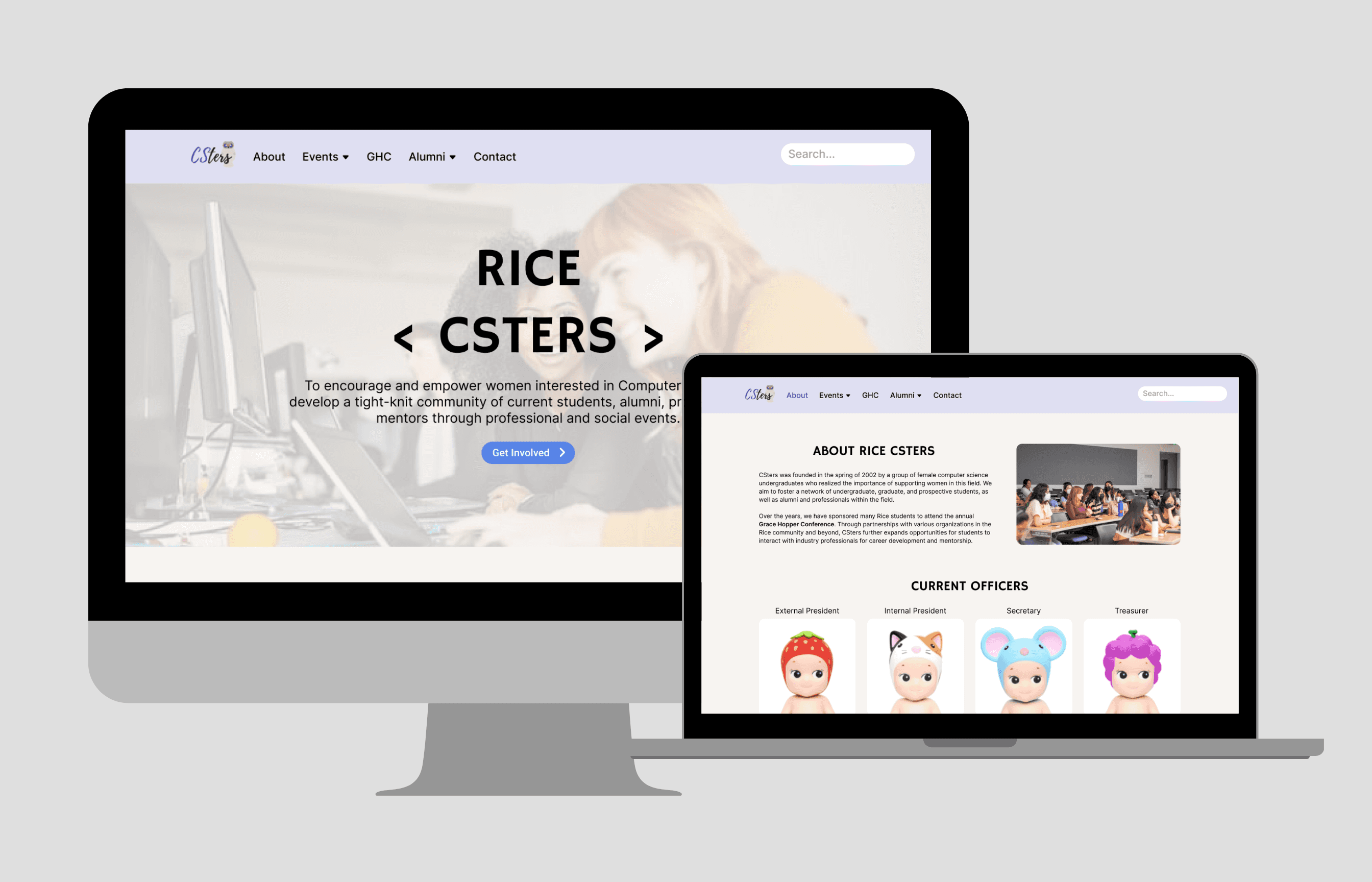
Rice CSters
Client Website Redesign
UI/UX Designer
1 Design Mentor
4 Designers
January 2025 - April 2025
Within the Rice Design Consulting 2025 cohort, I was selected, along with 3 other designers, to reimagine the website interface and functionality for Rice CSters.
Applying secondary research insights and client feedback, our team transformed Rice CSters' bare bones WordPress template into an engaging prototype that addresses core client and user needs. Highlights of our solution include call-to-actions, stronger branding, and more robust event and alumni sections, encouraging users to be more involved with the organization.
Above all, I am so, so grateful to our mentor, Maleah Brady. Her guidance through the design process steps has been invaluable to how I approach design today.
Who is Rice CSters?
Rice CSters is Rice University's organization dedicated to empowering underrepresented women in computer science. The name is a clever play on "CS" (computer science) and "sisters".
Their main objectives are to:
Foster a tight-knit network and community of students, alumni, and industry professionals
Sponsor students to attend the Grace Hopper Celebration (GHC), the world's largest gathering of women in tech
More information about Rice CSters: https://csters.rice.edu/
More information about GHC: https://ghc.anitab.org/
What's the Problem?
Before the initial client interview, our team took a glance at the current Rice CSters website.
"Any design is better than what we have right now." "website has minimal traffic
Alarm bells confirmed what we had been thinking.
In the initial client interview, this is the comment that stuck out to me the most. The existing website felt empty, generic, and visually unengaging.
key features/action they want users to focus on: info about joining club, event info
Home page: more eye-catching, pictures, continuous scrolling
Spotlight alumni
Prioritize listserv link, gcal, and insta
emphasize its a social club and open to all
user pain points:
people dont know hwo to join the organization
don't know about active events
don't know whwere to go for ghc info
website doesn't get much traction
users are confused when they go on the website
When our team first met with the Rice CSTERS leadership at Rice University, their message was candid: “Any design would be better than what we have right now.” The existing website felt empty, generic, and visually unengaging. With minimal imagery, weak content hierarchy, and little brand personality, it failed to communicate the energy and community-driven nature of the organization.
Through client interviews, we uncovered several critical gaps. The site did not clearly highlight the actions that mattered most—how to join the club, how to find upcoming event information, or how to stay connected through the listserv, Google Calendar, and Instagram. Key engagement pathways were either buried or visually deprioritized, making it difficult for users to take next steps.
From a user perspective, the pain points were even more pronounced. Students didn’t know how to join the organization, were unaware of active events, and were confused about where to find information related to GHC. Many visitors left the site without understanding that CSTERS is a social, open-to-all community. As a result, the website generated little traction and did not serve as an effective recruitment or communication tool.
Ultimately, the core problem was not just aesthetics—it was clarity, engagement, and identity. The website failed to reflect CSTERS’ vibrant community while also falling short as a functional hub for information and involvement.
How might we make Rice CSters' website more straightforward yet engaging so that users can more easily access information?
Let's Ideate!
We brainstormed a ton of solutaions and compiled our different solutions into an impact-effort map
My first encounter with using an impact effort map
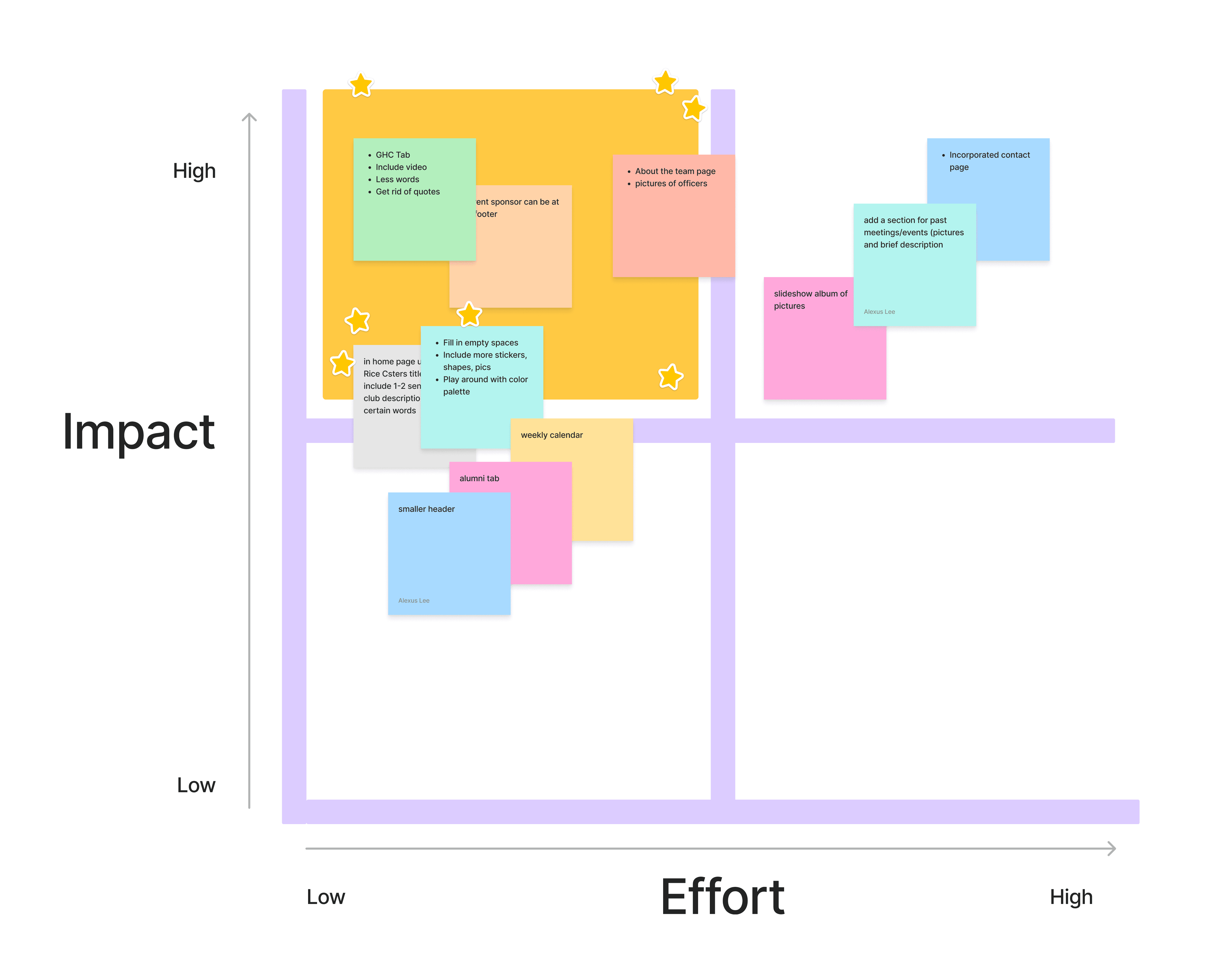
GHC is a huge event for Rice CSters so we wanted to focus on revampus that
As an org, Rice CSters cares a lot about gaining and maintaining sponsors
adding more visual design, fill in white space
wireframes!
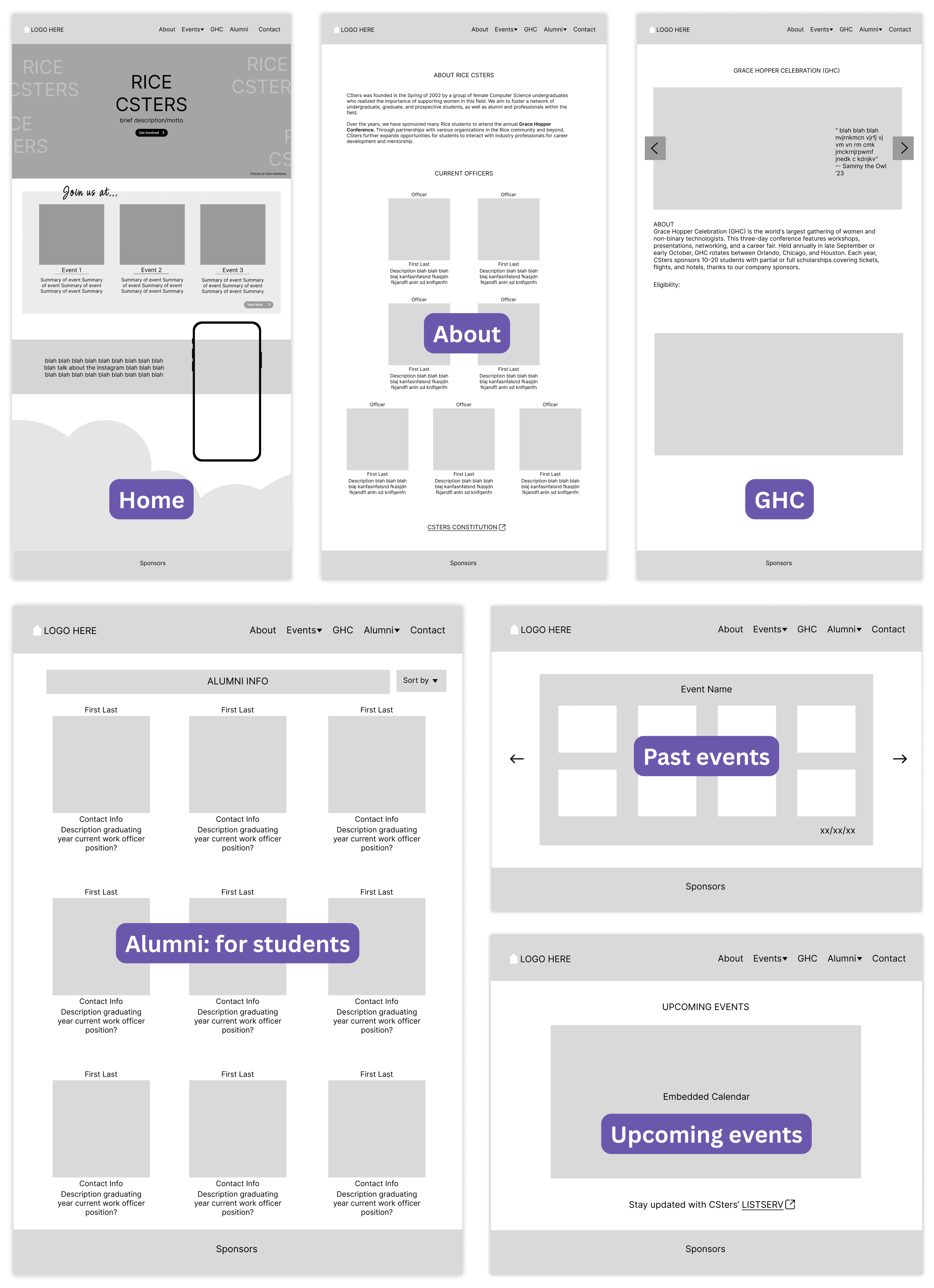
mid-fi, testing color
major thing that changed was aobut page layout
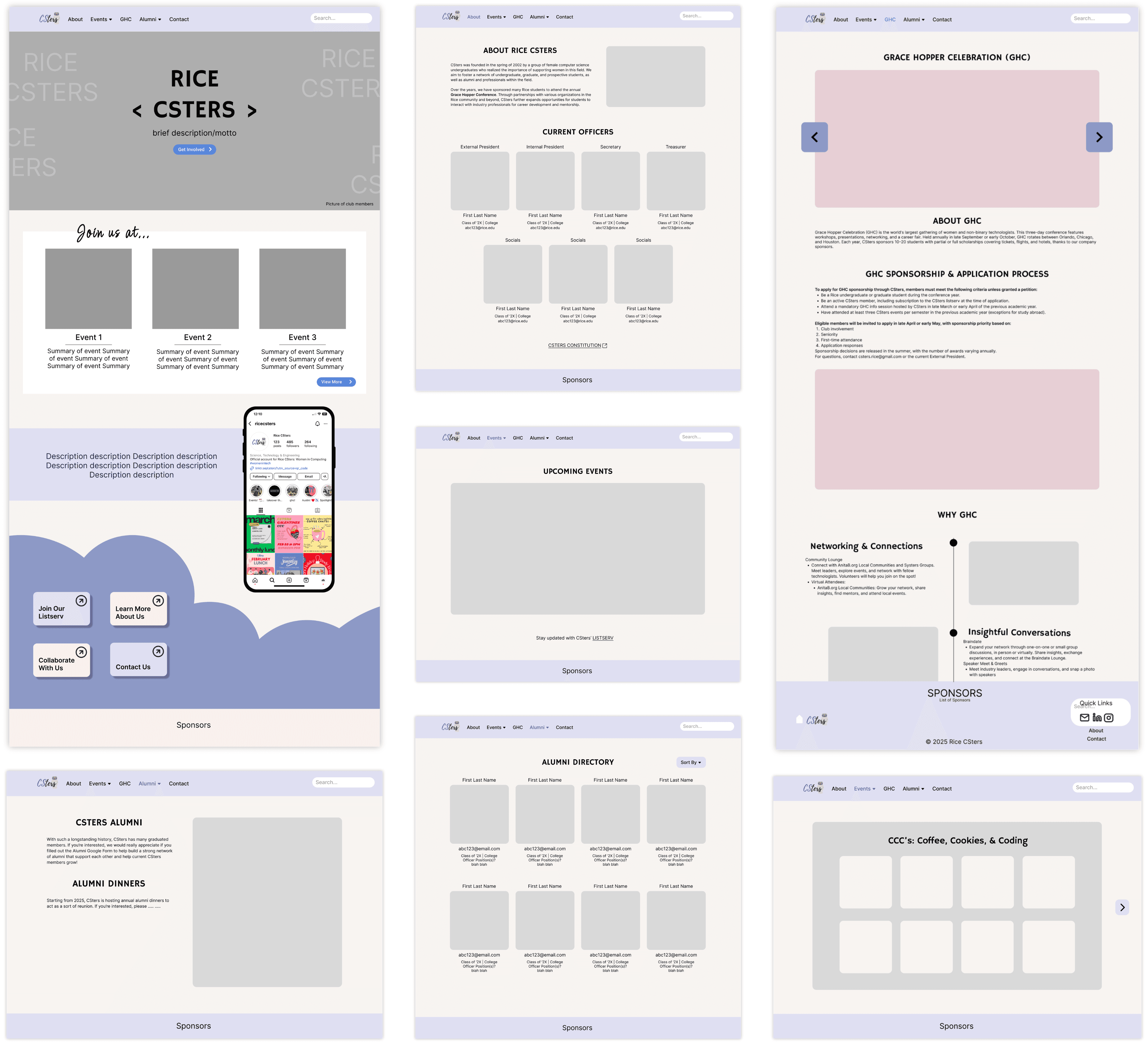
Client feedback
derp
Final Stages: Prototyping
After client feedback, here are hi-fi
Sign in/sign out:
Filtering and sorting:
Favorite a listing:
Viewing a listing:
Creating a new listing:
Profile page:
Here's the full high-fidelity prototype: Rice CSters Figma Prototype
What Now?
Our team presented the final design on April 19th, 2025 and officially handed it off to the client.
Rice CSters is still in the process of developing a code-based website.
Growth 🌱
OwlMart is my first time contributing to a 0-1 product with a cross-functional team, which calls for retrospection & reflection. After some post-MVP thought, here are my key takeaways:
1) Design decisions don't stop at handoff.
When design elements were altered or omitted in implementation (e.g., typography, spacing), I quickly discovered how much can get lost in translation. Especially as the sole designer, I learned to advocate for my choices, both to point out what needs change and articulate why it matters.
2) Adaptation is crucial in a non-linear process.
Restating my earlier point, implementation rarely matches the design 1:1. Even with clear communication, some elements simply aren't technically feasible (e.g., complex interaction animations), while others must be adjusted due to new constraints or insights. This experience taught me to keep an open mind and treat change as an opportunity for improvement.
Overall, seeing my designs come to fruition and have real-world impact has been incredibly rewarding, and I'm so thankful to my product team at RiceApps for making OwlMart possible :)
TO TOP